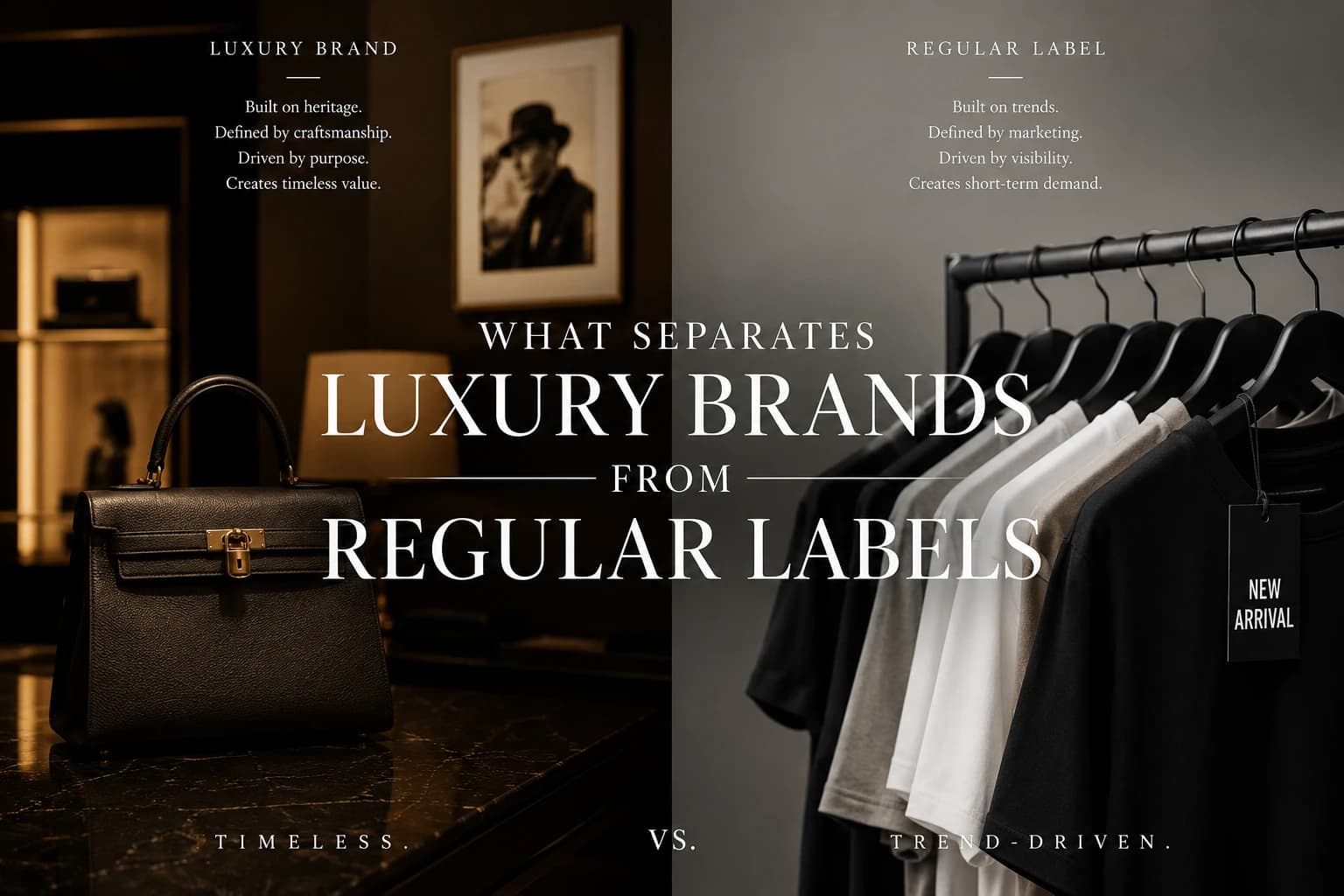
What Separates Luxury Brands from Regular Labels
Luxury is one of the most misunderstood words in modern business.
It is often mistaken for price and sometimes for exclusivity, and even occasionally for aesthetics.
More recently, it has become shorthand for anything expensive, beautifully packaged, or difficult
to obtain.
Yet none of these things, on their own, create luxury.
A product can command a premium price without possessing prestige. A hotel can be
beautifully designed without becoming memorable. A fashion house can sell out every collection
without ever becoming culturally significant.
Luxury begins where commerce ends because it is the point at which a business ceases to sell
products and begins to shape perception.
This distinction has become increasingly important in an era where almost every brand has
access to the same tools. Good design is accessible. Manufacturing has become global.
Marketing can be outsourced. Digital advertising has lowered the barriers to visibility. Artificial
intelligence has accelerated content creation.
The mechanics of building a brand have become increasingly democratic, but the mechanics of
building a luxury brand have not.
That is because luxury has never been defined by what a company produces.
It has always been defined by what a company represents.
The world's most admired luxury brands are not simply recognized because they make
exceptional products. They are remembered because they stand for something larger than the
products themselves. Their identity extends beyond what sits on a shelf or hangs in a wardrobe.
It permeates architecture, hospitality, craftsmanship, service, storytelling, and culture.
The product is merely the invitation but the world around it is what people truly buy into.
This is why luxury is best understood as an ecosystem rather than a category.
Consider the world's finest hotels, guests do not return simply because the beds are
comfortable or the finishes are exquisite. They return because someone remembered theirname. Because the lighting felt intentional. Because every interaction reinforced a feeling that
had been carefully designed long before they arrived.
Luxury exists in details that are almost invisible.
It is rarely loud, and it rarely needs to announce itself.
The same is true of exceptional restaurants, automobile manufacturers, private clubs,
watchmakers, or fashion houses. Their products may differ, but their philosophy remains
remarkably consistent. They obsess over experience rather than transactions. They think in
decades instead of seasons. They value consistency over spectacle.
Above all, they understand that trust compounds.
This is where many contemporary brands lose their way.
Modern business rewards speed. Markets reward constant novelty. Social platforms reward
attention above all else. Brands are encouraged to launch more frequently, speak more loudly,
and react more quickly.
Luxury, almost by definition, moves against the current.
While contemporary business rewards speed, constant visibility, and an endless appetite for
novelty, luxury has always found its strength in restraint. It understands that not every
collaboration enhances a brand's story, not every cultural moment demands a response, and
not every customer needs to be pursued. There is an uncommon confidence in knowing
precisely what belongs within a brand's universe—and, just as importantly, what does not.
This restraint is often mistaken for exclusivity. In reality, it is discipline.
Scarcity has never been the defining characteristic of luxury. Anyone can produce limited
quantities of a product. True luxury is scarce because its meaning is carefully protected. Every
decision, from the partnerships a brand forms to the spaces it inhabits and the experiences it
creates, either reinforces that meaning or diminishes it.
Over time, meaning evolves into something infinitely more valuable than awareness.
It becomes a reputation.
Unlike advertising campaigns or social media attention, reputation compounds. It deepens with
every consistent decision, every exceptional experience and every generation that discovers a
brand anew. It is one of the few assets that becomes more valuable with time rather than less.
This is perhaps where the greatest distinction between labels and luxury brands reveals itself.
A label competes for market share. A luxury brand competes for cultural significance.One asks how to sell more products. The other asks how to remain relevant long after those
products have disappeared.
The answer is rarely found in advertising budgets or marketing tactics. It lies in conviction—a
steadfast commitment to a singular point of view. The world's most enduring luxury brands
possess an extraordinary clarity of identity. They know who they are, what they value and,
perhaps more importantly, what they refuse to become. That clarity informs every decision they
make, from the products they develop and the partnerships they cultivate to the architecture
they commission and the experiences they design. Nothing feels arbitrary because very little is.
Such consistency creates something that cannot be manufactured overnight: enduring desire.
Not the fleeting desire fuelled by trends or engineered scarcity, but the quieter, more enduring
kind that survives generations. It is the desire that transforms a hotel into a destination, a
restaurant into an institution, a fashion house into a cultural symbol and a family business into a
global reference point.
This is why the world's greatest luxury brands increasingly resemble cultural institutions rather
than commercial enterprises. Their influence extends well beyond the industries in which they
operate. They shape taste. They establish standards. They influence design, hospitality,
craftsmanship and the way excellence itself is understood. Their success is measured not only
by revenue, but by the imprint they leave on culture.
For Africa, this distinction has never been more consequential.
Across the continent, a remarkable generation of founders is building ambitious businesses in
hospitality, fashion, design, wellness, real estate, technology and the creative industries. Many
will build successful companies. Some will build globally recognised brands.
But the more compelling question is which of them will build institutions.
Which hotel will come to define the spirit of an African city? Which restaurant will become part of
its cultural identity? Which fashion house will shape the global conversation around African
luxury rather than simply participate in it? Which founder will create a philosophy capable of
outliving both products and personality?
These are the questions that deserve our attention.
Because luxury is never built in a single campaign, collection or grand opening. It is built quietly,
through years of disciplined decision-making and an unwavering commitment to a singular idea.
It is the cumulative result of protecting a vision until that vision becomes synonymous with
excellence.
Every business begins by making something, the exceptional ones go on to mean something.
And in the world of luxury, meaning has always been the rarest commodity of all.
Chisom Njoku