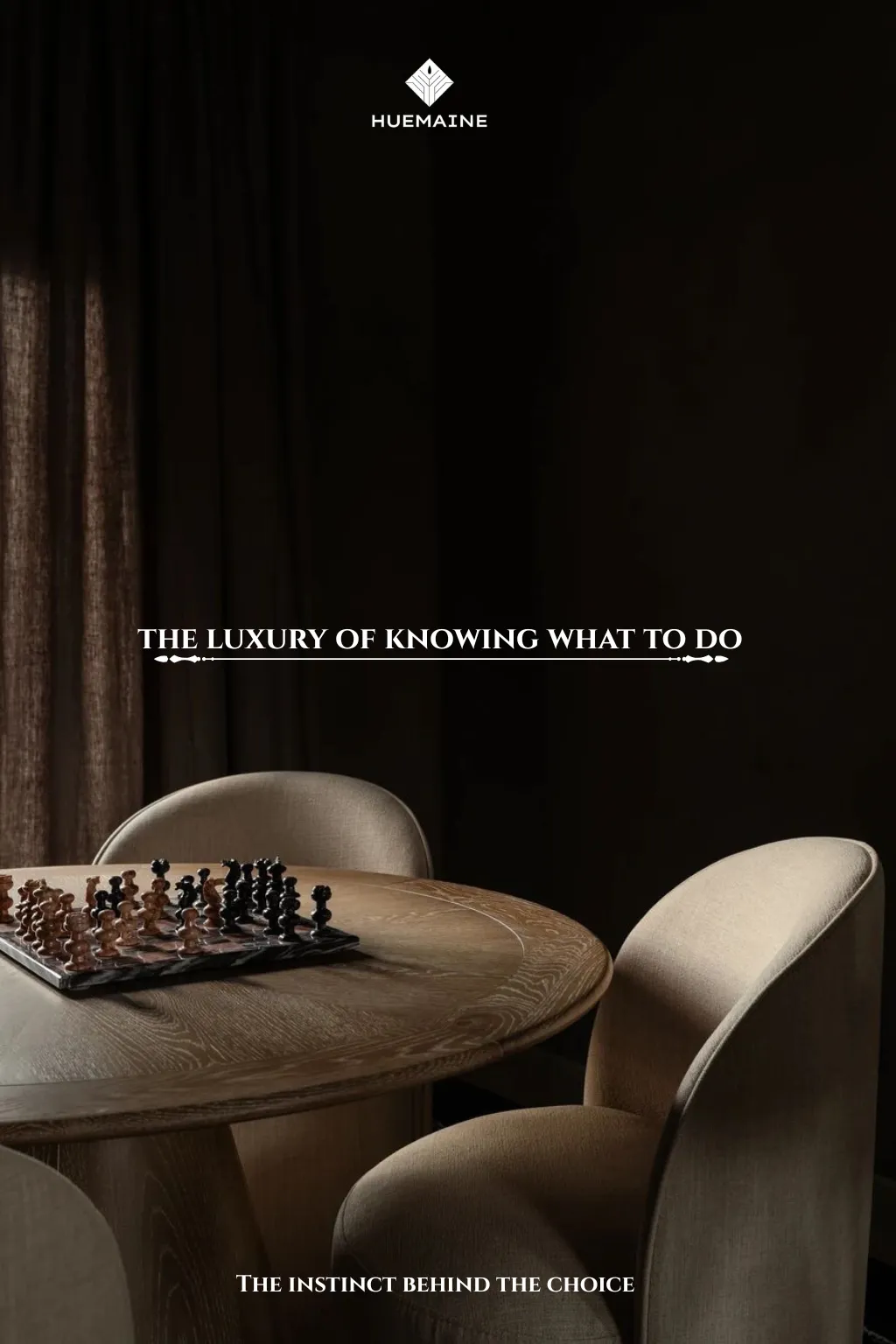
The Luxury of Knowing What to Do
Luxury is often understood through what can be acquired: the right address, the rare object, the beautifully made garment. But some of its most valuable forms cannot be purchased. They are carried quietly, revealed in moments when no one is watching closely enough to give instructions.
Knowing what to do is one of them.
It is knowing when to speak and when to let the room speak for itself. Knowing how to arrive without making an entrance, how to dress for a place rather than simply for a photograph, how to host without making hospitality feel like performance. It is the ease of understanding an environment before it asks anything of you. This kind of knowledge is rarely written down. It lives in observation, repetition and exposure. It is learned by watching how people move through spaces, how they treat service staff, how they behave when the occasion changes, how they recognise what a moment requires without needing to be told.
Sociologist Pierre Bourdieu’s idea of habitus offers a useful language for this. Taste is not only what we choose; it is also the instinct behind the choice. The practiced sense of what feels appropriate, what feels excessive, what belongs and what does not. Eventually, the knowledge becomes so familiar that it no longer feels like knowledge at all. It becomes instinct. This is where a quieter form of luxury emerges.
The luxury is not simply having access to beautiful places. It is knowing how to inhabit them. Not merely being invited to the table, but understanding the codes of the table. Not owning the wardrobe, but knowing what the occasion asks of it. Not travelling widely, but becoming fluent enough in different places to move through them with curiosity rather than performance.
In a culture increasingly designed to teach us what to want, knowing what to do becomes its own form of distinction. Social media has made access to references almost limitless. We can see the restaurant, the hotel, the outfit, the table setting, the destination. But seeing a reference is not the same as understanding it. Replication can reproduce the surface while missing the intelligence underneath.
True fluency is subtler. It allows a person to adapt without losing themselves. To understand that elegance is contextual, that hospitality has its own language, that every environment has a rhythm. It is the ability to read the room without becoming consumed by the room. Perhaps this is why the most compelling people rarely appear as though they are trying to demonstrate taste. Their choices feel considered because consideration has become second nature. The highest form of cultural knowledge may not be knowing what is expensive. It may be knowing what the moment requires.
Nelo Okpala